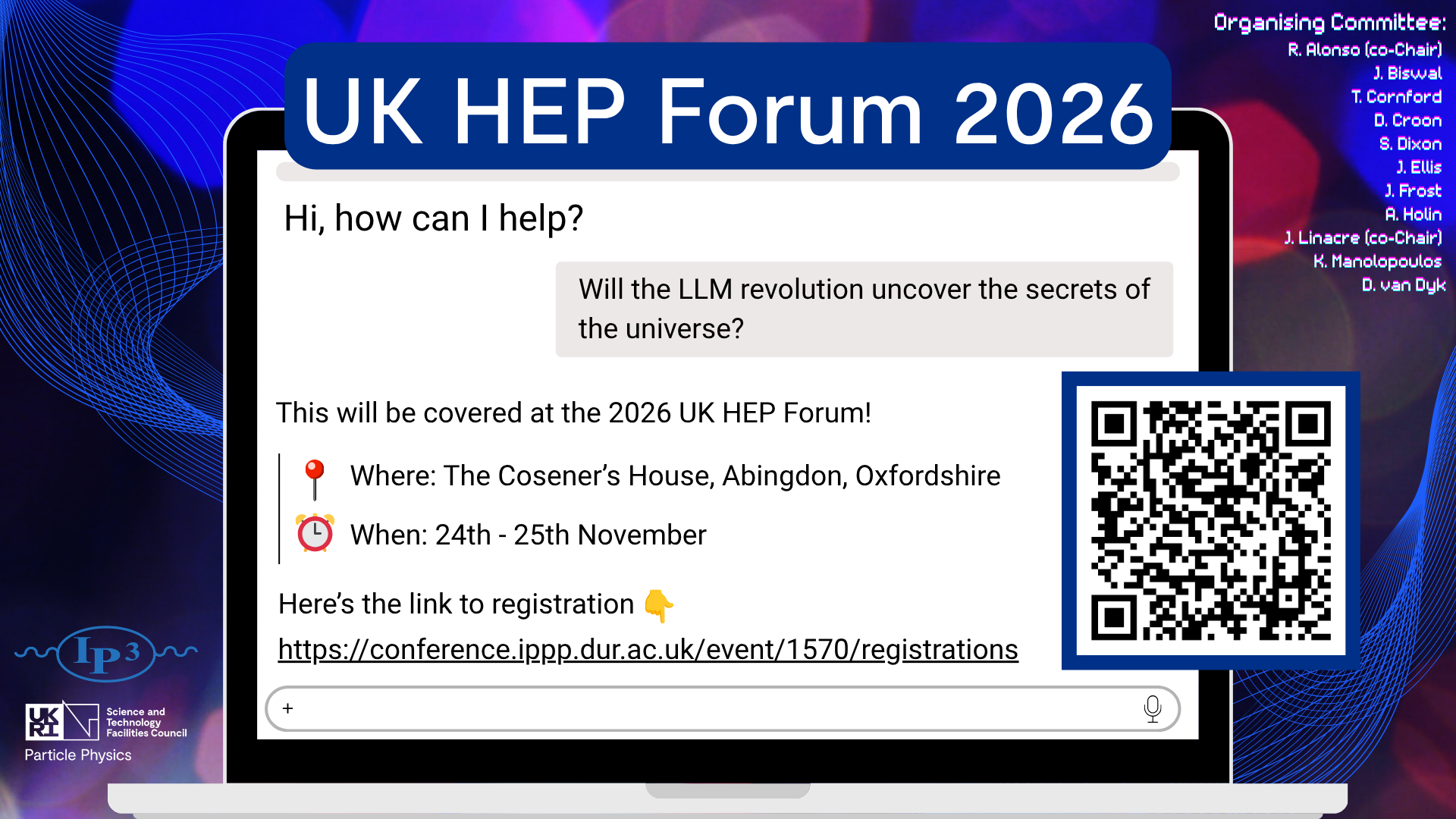
UK HEP Forum 2026: "Will the LLM revolution uncover the secrets of the Universe?"

→ Europe/London
Jacob Linacre (STFC RAL), Rodrigo Alonso (Durham)
Description

The UK HEP Forum 2026 will take place on 24-25 November at The Cosener's House in Abingdon, Oxfordshire, and also broadcast via Zoom.

Large Language Models are reshaping what is possible in high energy physics — from automating routine analysis to acting as active partners in literature synthesis, hypothesis generation, and complex scientific workflows. But will they genuinely transform fundamental discovery, or merely accelerate what we already know how to do? This workshop brings together experimentalists and theorists to critically examine the promise, the pitfalls, and the profound implications of LLMs for the future of HEP.1

In-depth presentations will be given by invited speakers. In addition, the forum will feature a session of short talks giving UK PhD students the opportunity to present their work in all areas of HEP. Interested students are encouraged to submit a talk via the registration form.

The forum is sponsored by the IPPP and STFC. There is no registration fee. Accommodation will be free of charge for all attendees. Travel expenses within the UK (ground transport only) will be reimbursed to students who present a talk.

Registration is required and is open to participants with UK affiliation only. We look forward to welcoming you.

UK HEP Forum Organising Committee [R. Alonso (co-Chair), J. Biswal, T. Cornford, D. Croon, S. Dixon, J. Ellis, J. Frost, A. Holin, J. Linacre (co-Chair), K. Manolopoulos, D. van Dyk]

Email: UKHEPForum@stfc.ac.uk

1 Paragraph prepared using Claude Sonnet 4.6 Thinking

Participants
    • 20:00
      Dinner
    • 10:00
      Registration and coffee
    • 1
      Welcome
    • 2
      HEP: the big questions
      Speaker: Gavin Salam (University of Oxford and All Souls College)
    • 3
      Collider anomalies, tensions, and opportunities
      Speaker: Sara Alderweireldt (University of Edinburgh)
    • 4
      Noncollider anomalies, tensions, and opportunities
      Speaker: Juri Smirnov
    • 12:45
      Lunch
    • 5
      Introduction to LLMs
      Speaker: Pontus Stenetorp (University College London and BritLLM)
    • 6
      LLMs in industry
      Speaker: Dr Gabriel Facini (University College London)
    • Student talks
      Conveners: Jyoti Prakash Biswal (Rutherford Appleton Laboratory, STFC, UKRI), Konstantinos Manolopoulos (Rutherford Appleton Laboratory - STFC)
      • 7
        Dirac neutrino portal to SU(2)D dark matter

        This talk will introduce a new "Dirac neutrino portal to SU(2)D dark matter" model, a promising model where the smallness nature of the active SM-neutrinos arises naturally, even considering sizeable values for the yukawa coupling. Also, two new possible DM candidate are present in this model.

        Speaker: Gonzalo Benítez (University of Southampton)
      • 8
        AgentRivet

        The speaker will give a brief on the motivation for this tool (Rivet routines are sustainable software, facilitating comparison of LHC measurements to new calculations and models) before highlighting some recent development work (building a benchmark of AgentRivet performance).

        Speaker: Joseph Egan (University College London)
      • 9
        AI4Math4Physics (on Zoom)

        This talk will cover the AI4Math revolution, its downstream potential for theoretical physics, and the technologies emerging from it.

        Speaker: Roi Vence-Nogueira (Peking University)
      • 10
        Scattering Amplitudes as Programs: Self-Evolving Search for Theory and Event Generation

        In this talk, the speaker will briefly discuss how AI-driven, self-evolving approaches can be used to explore scattering amplitudes.

        Speaker: Yi Gu (University of Cambridge)
      • 11
        Constraining an Electron Majorana Mass
        Speaker: Alif Khan (University College London)
      • 12
        Diffusion models for exploring the string landscape with LLM-assisted research

        We use discrete diffusion models to learn and generate Type IIB flux vacua across multiple Calabi–Yau geometries. The project was developed with extensive use of LLMs and coding agents for implementation, debugging and experimentation, while scientific decisions and the overall workflow remained human-directed. I will discuss both the physics results and what this experience suggests about the role of LLM-based tools in theoretical physics research.

        Speaker: Zhimei Liu (University of Cambridge)
      • 13
        Displaced signals in neutrinoless double beta decay
        Speaker: Noor-Ines Boudjema (University College London)
      • 14
        Hunting Semi-Visible Jets with Machine Learning at the LHC
        Speaker: Miguel Angel Avendano Bernal (University of Southampton)
    • 16:30
      Coffee break
    • 15
      Proving theorems using LLMs
      Speaker: Sven Krippendorf (University of Cambridge)
    • 16
      AI and QCD
      Speaker: Daniel Maitre (IPPP)
    • 17
      LLMs and AI and phenomenology
      Speaker: Tilman Plehn (Heidelberg University)
    • 19:30
      Dinner
    • Hotel room checkout
    • 18
      LLMs: research tool or research assistant?
      Speaker: Veronica Sanz
    • 19
      LLMs and scientific integrity
      Speaker: Joseph Tooby-Smith (University of Bath)
    • 20
      Physics and Prompts forum
      Speaker: Djuna Croon (IPPP Durham)
    • 10:45
      Coffee break
    • 21
      Computing, grid and sustainability
      Speaker: Alastair Dewhurst (STFC)
    • 22
      Transformers for low-energy neutrino triggers in Hyper-Kamiokande
      Speaker: Saúl Alonso-Monsalve
    • 23
      LArTPC LLMs
      Speaker: Leigh Whitehead (University of Cambridge)
    • 13:10
      Lunch
    • 24
      What can LHC triggers learn from LLMs?
      Speaker: Benedikt Maier
    • 25
      Using LLMs for physics analysis
      Speaker: Caterina Doglioni (University of Manchester)
    • 26
      Future of LLMs in HEP
      Speaker: Daniel Murnane (NBI, Copenhagen and LBL, Berkeley)
    • 27
      Farewell (taxis depart 16:15)