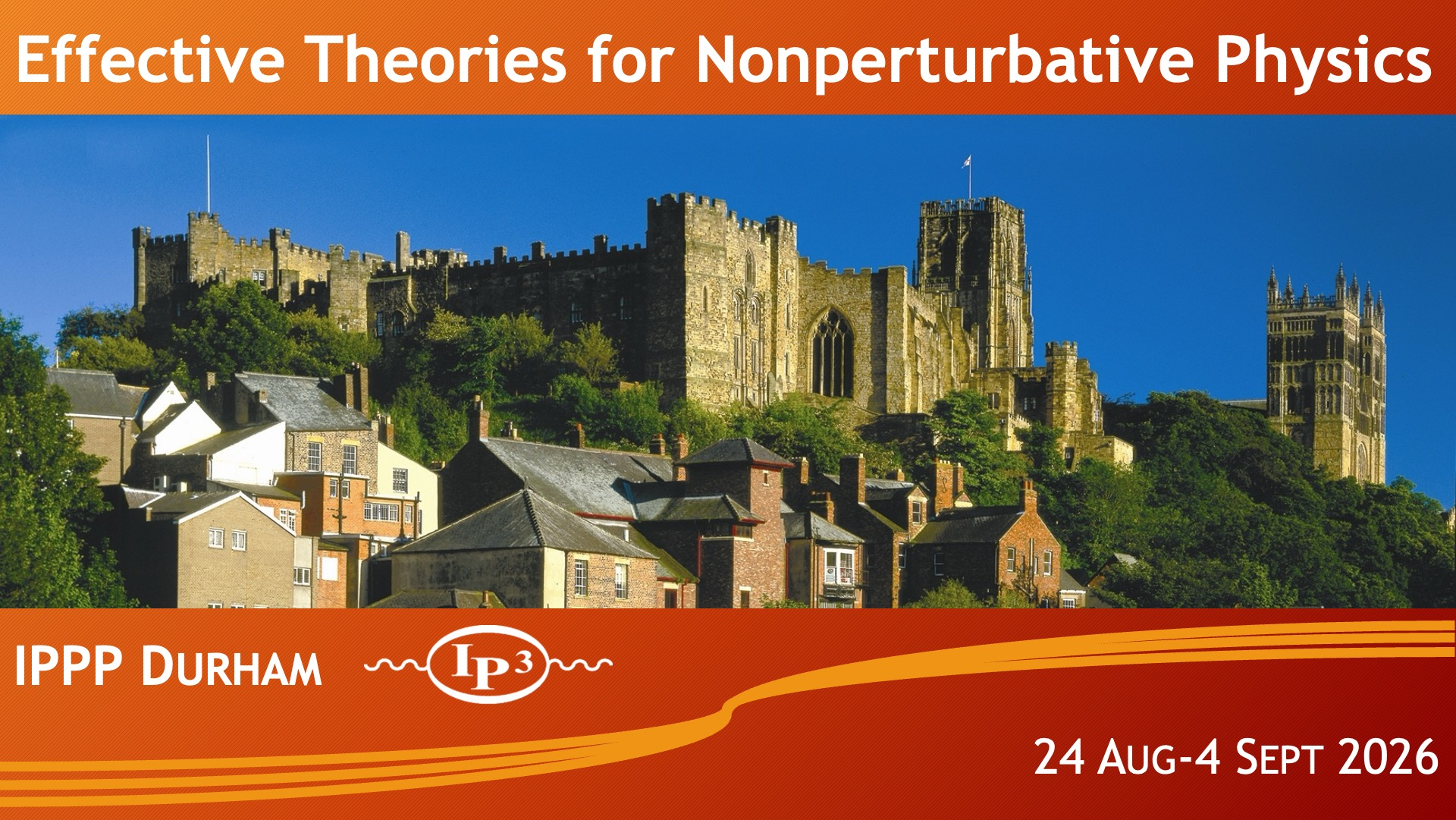
This workshop, hosted at the IPPP in Durham, continues a series of meetings on Effective Theories for Nonperturbative Physics previously held at CERN and MITP, Mainz. Its goal is to further develop a growing and interdisciplinary community focused on constructing and exploiting effective descriptions of nonperturbative dynamics. A central theme is the interplay between different frameworks, and the extent to which they offer complementary insights into regimes where conventional perturbative expansions break down. The workshop will place particular emphasis on fostering new connections across subfields, including among early career researchers.
Strong coupling and other nonperturbative regimes arise generically in quantum field theory, yet remain comparatively less well understood than their perturbative counterparts. Developing controlled and quantitative descriptions of nonperturbative phenomena is therefore an important objective, both in its own right and for its implications across a wide range of areas. The workshop will highlight the wide variety of qualitative behaviours that emerge in such regimes, and the extent to which they can be captured and organised using effective theoretical frameworks.
We envision the thematic focus of talks and discussions to include:
- Perturbation theory at large quantum numbers and all-orders structures
- Tunnelling phenomena and false vacuum decay at zero and finite temperature
- Hamiltonian truncation and related Hamiltonian approaches
- Topological objects and their phenomenology (instantons, sphalerons, strings, domain walls)
- Nonperturbative phenomena in quantum field theories relevant for phenomenology and model building, including those studied on the lattice
- Interfaces with emerging methods, including quantum computing and quantum simulation, as tools for accessing nonperturbative dynamics
The programme will consist of a mix of research talks and guided discussions, with ample time dedicated to informal collaboration building and exploration of new ideas. A central goal of the workshop is to encourage crosstalk between communities that do not typically interact closely, and to catalyse new ideas and collaborations aimed at tackling nonperturbative problems from multiple perspectives.